Showing posts with label thought. Show all posts

Thursday, July 7, 2011

My thoughts on "I, Robot" by Isaac Asimov

I read this classic book recently and I thought it was good enough to write down my thoughts about it. These are put together without real form – they are rough, but I’m not trying to write an essay. Also, if you want to understand me, you probably should read the book first.
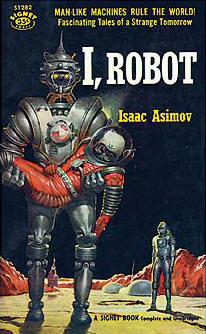

Here’s a summary: I, Robot is a collection of short stories within the same “universe” in the future. They all involve Dr. Susan Calvin, a “robopsychologist,” in some way, as she analyzes the problems with the robots in the scenarios. She works for U.S. Robots and Mechanical Men Inc., a company that revolutionized robotics and made the “positronic brain,” the mechanism or device that allows robots to think on the level of humans. But, since humans made the robots basically from scratch, there are overlooked, complex problems that arise. The short stories involve various situations that could happen, such as an advanced robot that thinks humans are inferior, robots being confronted with paradoxes or contradictions, or problems with allowing robots to deal with more danger. One strong element that the book is remembered for is Asimov’s 3 Laws of Robotics, which were his thoughts on how we would have to deal with robots and make them safe. Roughly: robots can’t harm a human being, they must obey human orders, and they must be able to protect their own existence, but in that order of priority.

-Asimov does express well the idea of robots being common, to the point that the humans take them for granted.
            -reporter and Dr. Calvin talk about the time before robots, reporter doesn’t recognize it
            -the family in the beginning and the scientists who aren’t roboticists deal with robots as if they don’t care about interacting with them on a deeper level, where they understand what is going on in the robot. We can see this today too with robots, but now people will just shy away and not interact at all. Asimov shows how it would be like if robots became much more “common.”

-On that last thought, the people don’t recognize the importance of what is going on when something goes wrong.
            - Even though the robots are so variable and flexible to understand human thinking, they should be precise (by today’s standards).
            - Breaking the 3 laws means something is seriously wrong in that world, and there should be more safeguards against it.
            -The humans shouldn’t get annoyed and act like the robot is just “stupid,” or like their coffee maker broke and they can’t have their coffee.
            -We see this today with cars and computers, but these robots are much more complex and concern more important implications. It’s like a fighter jet that breaks in flight and the pilot has to figure out what happened and land quickly because his life is in danger.

-The technology:
            -The positronic brain (Data!) is truly this fix-all technology. Asimov doesn’t really even consider that it is a powerful computer. Multiple indications show that it is not computer-based, specifically that it isn’t really “programmed,” it is mostly just “made.”
            -The name implies it is a quantum computer, allowing for smaller, faster, and more natural computing. This seems plausible (people are researching it now). But only if it is based off the positron particle, or some principle or interaction related to it. or only using the positron briefly on in a reaction. This is because the positron is an antiparticle (the “opposite” of an electron) and annihilates when it touches other matter. It would seem difficult to build with and use.
            -The emphasis on mechanics and mathematics instead of electronics and programming is clear. The robots are very mechanical, use more metal instead of some plastic here or there, not much mention of electronics, wires, or circuits (though I don’t think people were that far in electronics when this book was published). A lot of gears, etc. are mentioned, instead of what we would find prevalent in robots today.
            -The don’t realize how prevalent computers would become! “Oh, these calculations are so difficult! They must have a computer here in this facility that we can use!” “When the drawing board and slide-rule men said it was ok…” That’s why sometimes the robots are so wondrous, because Asimov didn’t really know how they could be made. He really only knew that we would have to recreate humans from scratch, so to speak, and there are many emotional things that are difficult and would cause problems.
            -I find it interesting how the first “talking robots” were a big advancement, and that robots with emotion came first. Now a days we would think it would be the other way around, that we would have talking robots that didn’t fully understand what they were saying because they didn’t have emotion, but that robots with emotion would come later.

-The 3 Laws are “built” into the brain. Human actions are so complex, I don’t know how this could be accomplished. It’s difficult enough to make a machine that understands and truly copies human qualities, but I think more difficult is that it recognizes bad situations on its own. (But I guess if you have wondrous technology that can do the former, it could do many other difficult things too).
            -The robots go “insane” when confronted with a contradiction or paradox concerning the 3 laws. Modern robots would likely have better, careful safeguards and would be able to recognize when something is wrong, either on a large or small scale. It would be testing itself and communicate with humans if something went wrong.
            -The robots are so good at displaying emotion that they do it in extraneous ways. “Oh my, hurt coming to humans! My goodness, what a thought!” I think modern robots would be much more precise and not frivolous.

Friday, December 31, 2010

Some culture and values of maker/hacker community

While I'm not an expert on describing this concept accurately or from experience, I think it is a great thought and should be mentioned.

The large community of makers, hackers, tinkerers, inventors, experimenters, and explorers have a sort of unique mindset of what they do and why. They are not out to destroy (sometimes common definition of hacker), collect junk, or make impractical things. They want to learn, explore, innovate, teach, and help others do the same. From this mindset comes things like open source development, hacker-space communities, being self-taught and self-dependent, and fixing your technology instead of replacing it. You can imagine some of the benefits, such as an inviting, user-friendly way to learn and a strong method for developing and discovering new ideas and technologies. This is an amazing and interesting initiative and I agree with it wholeheartedly.

One thing I'd like to mention more thoroughly is the concept of being free to fix your own technology. Instead of just junking your broken toaster, toy, phone, or computer, try cracking it open and fixing it yourself. You'll save money and it's more efficient than recycling, and you might even have some fun or learn something (gasp!) as you figure out how the object works and how to fix it. It also gives you a sense of ownership and connection; as the maker saying goes, "if you can't open it, you don't own it." With this comes some "rights" that makers lobby manufacturers for and strive to use themselves whenever making or developing something. These are quite interesting and make some good points. I've attached pictures of two motto/creeds/listings of rights. One is the Maker's Bill of Rights by Mister Jalopy. The other is the iFixit Repair Manifesto. iFixit is a website that instructs people how to repair their broken iPhones, computers, etc. so that they can be reused.

I write this post after being reminded/inspired from my last project when I fixed our broken remote.


Sunday, October 10, 2010

Focus-of-vision-based laser pointer

I've had this idea for a while about something that would point a laser at whatever you were looking at. This is mainly an idea for applying to many people in a room and being able to see where people are looking, for example, during a presentation. This wouldn't be a practical purpose, just a study or an experiment. You'd likely see many people wandering their eyes and also many people looking at and reading the words on a presentation screen when the slide changes. I think it would be interesting to try out.

To make it, you could have a camera pointed at the persons eyes or one of their eyes. It would be mounted on a hat or helmet and positioned off to the side, essentially out of their main area of vision. It would track the pupil and calculate in what direction the person was looking. A laser, also attached to the hat, would point in the direction the person is looking. It would be moved by motors.

One of the issues would be trying to get the laser pointing in the exact spot the person is looking at. Because it is mounted off to the side or on top of the head, there would be an offset to the paths of vision and laser. Because of the person's focus and how far away the object is that they're looking at, the laser would not always be accurate. The side-side offset could be solved by mounting on the top of the head, or one could use a distance sensor (ultrasonic, etc) to try and find the distance to the object being looked at. Using a sensor wouldn't completely solve it, but it would help if the person was looking at a large object like their desk or the wall in front of them. The sensor might miss if they were looking at a smaller object like the presenter or a demonstration object.

Saturday, August 21, 2010

Mindstorms NXT Color Sorter

Found on Tinkernology: http://tinkernology.blogspot.com/2010/08/color-sorter.html
Robot maker's website: http://robotics.benedettelli.com/ (looks like there many other cool robots there)

A very very nice color sorter with an arm that picks up and places colored balls. A color sensor is on the ball rack. It uses RC servos in the arm, which is cool that they could integrate that with NXT. The ball containers are fairly clever too.


What's nice about this robot is that it is very fast and efficient. Other robots you might see (this could be anywhere) move slowly and ultra-methodically like they are running on a low-level computer. These are common among x-y plotters and unique walking or climbing robots. It is hundreds of times more impressive and efficient when things move faster and the robot multitasks movements. Call me arrogant if it really does take this level of processing and precision, but often in these cases it seems to an observer that the robot is not well developed in some way. At least let me say that if the video has to be sped up 8x to keep the person from falling asleep, there might be a problem.

Tuesday, July 20, 2010

American mindset of purposeful advancement

Popular Science had an article in their recent August 2010 magazine about humanoid robots. It was specifically about RoMeLa's (Virginia Tech) Charlie-L and how it's basically the first and only humanoid robot in America, where as Asian countries have loads of them (think ASIMO, etc).

Here was one quote that I found intriguing and that slightly sums up why America doesn't have more humanoids:
(Daniel Lee, co-runs RoMeLa):
"If you write a proposal here for a robot that plays music, you'll have a very hard time finding funding. What's the practical purpose?...Yet if a robot improvised a jazz performance, it might teach you all sorts of things about artificial intelligence and even human intelligence. There's more openness to that kind of investigation in Asia and Europe. Here the focus is on a well-defined problem."
I have seen this in American thinking and it frustrates me. There are some college students who made an interesting breakthrough in technology, interfacing, or control. They describe it all nicely and you get to the end and they give their cobbled-up answers to what this could be useful for. You can easily tell they are thought up to work with their professor's assignment or to make sense to a sponsor. Then they continue to explain half of their other work, which is how to eventually integrate this technology into our lifestyle. What's wrong with exploring technology for the purpose of exploring it? Sure, the process and information can be formatted so that someone later can use it for something helpful and the work shouldn't be "pointless." But sometimes the purpose should just be to learn more about ourselves, our world, and what we can do with it; that kind of knowledge is beneficial and exciting enough. There doesn't always need to be an initial problem.

Saturday, July 10, 2010

Engineering reliance and independance quote

Here's a very intriguing quote by oakshaman in a review on Amazon about a mechanisms book I plan to buy:

"The many crisp line drawings are presented with a minimum of explanation and no dimensioning. You see, it was assumed back in those days that a person with natural mechanical aptitude could look at a diagram, or a machine, and figure it out. Not only that, but it was assumed that once you had the idea, then you could work out all the details for yourself without having to be told everything down to the last screw size. While there is a descriptive paragraph indexed to every drawing, most of the time you don't really need it.

This book comes from an age when engineers and designers had to have the talent and the knowledge to use the mechanical principles of levers, linkages, cams, gears, etc. to produce a given motion- and to link together many such elegant little mechanisms to get a bigger job done- reliably. This isn't done much anymore. Now most machines are huge, cobbled-up, Rube Goldberg devices of pneumatic or hydraulic cylinders, screw actuators, or servo motors- all interconnected by electronic controllers. The whole thing is controlled by software of even more dubious reliability.

Up to the "digital revolution", this book shows how it was always done- it's how I learned it. Of course, once upon a time, a mechanical designer actually had to understand machinery, and the basic principles of physics, and not just how to write code...."
It just about puts a whole new perspective on how you look at things like this. Well said!!