From Makezine.com: http://blog.makezine.com/archive/2011/04/the-awesome-button.html
A nice, simple How-to for repurposing the Staples Easy Button into a USB device. It can be connected to a computer and act like a keyboard or mouse, in this case automatically typing out a synonym for "awesome" when pressed. It uses a TeensyUSB, a spin off (version?) of the Arduino platform connected to the main switch for the button. I really like this hack because it's so simple and opens up a lot of possibilities.
Sunday, July 17, 2011

Fixing my OTHER white desk fan
My family has another fan just like the one I tried to improve before. This one is white, and it also didn't work at all. When you would turn it on, it would struggle to start and move. So I was "commissioned" to fix it.
The fan was quite dusty, so I thought maybe a carpet hair or a piece of dust was stuck somewhere. I blew it with our garage air compressor and wiped it down with a rag, but that didn't do anything (I wasn't expecting much). I opened it up, this time going for the motor, instead of the swivel point like the last fan. It works after taking it apart and putting it back together. I think the motor was scraping against its housing or a pesky piece of dust, which stopped it. It might have been an electrical problem, though, but I think that's less likely.
View photos here on Google Web Albums with explanations of the process in the captions. These photos follow parts of the "story" of taking the fan apart.
Note that you should probably look at my first fan fixing post, since I won't explain some of the parts already seen and explained there.
Thursday, July 7, 2011
My thoughts on "I, Robot" by Isaac Asimov
I read this classic book recently and I thought it was good enough to write down my thoughts about it. These are put together without real form – they are rough, but I’m not trying to write an essay. Also, if you want to understand me, you probably should read the book first.

Here’s a summary: I, Robot is a collection of short stories within the same “universe” in the future. They all involve Dr. Susan Calvin, a “robopsychologist,” in some way, as she analyzes the problems with the robots in the scenarios. She works for U.S. Robots and Mechanical Men Inc., a company that revolutionized robotics and made the “positronic brain,” the mechanism or device that allows robots to think on the level of humans. But, since humans made the robots basically from scratch, there are overlooked, complex problems that arise. The short stories involve various situations that could happen, such as an advanced robot that thinks humans are inferior, robots being confronted with paradoxes or contradictions, or problems with allowing robots to deal with more danger. One strong element that the book is remembered for is Asimov’s 3 Laws of Robotics, which were his thoughts on how we would have to deal with robots and make them safe. Roughly: robots can’t harm a human being, they must obey human orders, and they must be able to protect their own existence, but in that order of priority.
-Asimov does express well the idea of robots being common, to the point that the humans take them for granted.
-reporter and Dr. Calvin talk about the time before robots, reporter doesn’t recognize it
-the family in the beginning and the scientists who aren’t roboticists deal with robots as if they don’t care about interacting with them on a deeper level, where they understand what is going on in the robot. We can see this today too with robots, but now people will just shy away and not interact at all. Asimov shows how it would be like if robots became much more “common.”
-On that last thought, the people don’t recognize the importance of what is going on when something goes wrong.
- Even though the robots are so variable and flexible to understand human thinking, they should be precise (by today’s standards).
- Breaking the 3 laws means something is seriously wrong in that world, and there should be more safeguards against it.
-The humans shouldn’t get annoyed and act like the robot is just “stupid,” or like their coffee maker broke and they can’t have their coffee.
-We see this today with cars and computers, but these robots are much more complex and concern more important implications. It’s like a fighter jet that breaks in flight and the pilot has to figure out what happened and land quickly because his life is in danger.
-The technology:
-The positronic brain (Data!) is truly this fix-all technology. Asimov doesn’t really even consider that it is a powerful computer. Multiple indications show that it is not computer-based, specifically that it isn’t really “programmed,” it is mostly just “made.”
-The name implies it is a quantum computer, allowing for smaller, faster, and more natural computing. This seems plausible (people are researching it now). But only if it is based off the positron particle, or some principle or interaction related to it. or only using the positron briefly on in a reaction. This is because the positron is an antiparticle (the “opposite” of an electron) and annihilates when it touches other matter. It would seem difficult to build with and use.
-The emphasis on mechanics and mathematics instead of electronics and programming is clear. The robots are very mechanical, use more metal instead of some plastic here or there, not much mention of electronics, wires, or circuits (though I don’t think people were that far in electronics when this book was published). A lot of gears, etc. are mentioned, instead of what we would find prevalent in robots today.
-The don’t realize how prevalent computers would become! “Oh, these calculations are so difficult! They must have a computer here in this facility that we can use!” “When the drawing board and slide-rule men said it was ok…” That’s why sometimes the robots are so wondrous, because Asimov didn’t really know how they could be made. He really only knew that we would have to recreate humans from scratch, so to speak, and there are many emotional things that are difficult and would cause problems.
-I find it interesting how the first “talking robots” were a big advancement, and that robots with emotion came first. Now a days we would think it would be the other way around, that we would have talking robots that didn’t fully understand what they were saying because they didn’t have emotion, but that robots with emotion would come later.
-The 3 Laws are “built” into the brain. Human actions are so complex, I don’t know how this could be accomplished. It’s difficult enough to make a machine that understands and truly copies human qualities, but I think more difficult is that it recognizes bad situations on its own. (But I guess if you have wondrous technology that can do the former, it could do many other difficult things too).
-The robots go “insane” when confronted with a contradiction or paradox concerning the 3 laws. Modern robots would likely have better, careful safeguards and would be able to recognize when something is wrong, either on a large or small scale. It would be testing itself and communicate with humans if something went wrong.
-The robots are so good at displaying emotion that they do it in extraneous ways. “Oh my, hurt coming to humans! My goodness, what a thought!” I think modern robots would be much more precise and not frivolous.
Saturday, July 2, 2011
Fixing my wobbly desk fan
I unscrewed and opened up my desk fan to try and see if I could keep it from being so loose and wobbly. I thought maybe something could just be tightened. I found that the looseness comes from two things: the arm that pushes and pulls the fan from side to side is purposefully designed to be loose, and the turning axle does not have a good fit. Since the first is on purpose because of how the fan is designed, I can't really fix that (bad design of fan, then?). The second is too hard to fix, since I can't easily make a new axle or add material to make the fit tighter. See the pictures below for more details on the various things I saw.
Overall Pictures


Overall Pictures


Here's the arm that pushes and pulls the fan side to side. It's the double-angled piece of metal that is attached to a large plastic gear and the fan's base. The gear turns and pushes and pulls against the base, which stays still, so the fan moves. One of the holes on the arm is oblong and both screws are very loose. This makes it flexible and not bind up when it moves through all possible angles, but also makes the connection loose. It moves fine, but it will wiggle a lot if touched.

Here's the switch, which looks like a variable resistor with 4 states.

Here's a closeup on the magnetic coils for the motor. The coils are the black plastic underneath the main metal housing and behind the large gear. Notice the laminated iron core going through the coils and around the motor to strengthen the magnetic field and reduce eddy currents.

Here's the inside of a gearbox that directs power from the motor/fan blades to the side-to-side motion of the fan.
The silver axle extending towards the viewer comes from the motor and is a worm gear. I don't remember checking to see if there was a worm gear attached, milled into the axle, or if there are indications of the end of the axle having normal screw threads. I wonder if the last option might be easier to manufacture.
The knob lifts the white gear up out of the worm gear, turning off this motion. This seems to be a good way of getting "in and out of gear."

Here's the hole with the screw that holds the turning axis in place.


Without the screw.

Here's the tiny screw that is used for the above pictures. Not very strong, I would guess. Is this the source of the wiggle? Does it need to be tightened or replaced with a longer, bigger one? Further research indicates not really.

Here's the axle connection. The metal ring seems to a bearing so that things don't scrape too much.

Here's the axle after the screw is taken out. Now we see that there is a groove all the way around the axle where the screw fits in, keeping the fan attached to the base. So the screw and this groove are what take the weight in this area when the fan is picked up from above. Noting the size of the screw above, not a design I would trust.

Nothing much to see from this view.

Another axle picture. The bearing is sort of loose and slides up and down a bit, you can see the gap here.

I tried to get a picture of the other end of the axle to see how it was attached. All I can see is the hole in the metal where it is attached. Clearly it was put on there before the fan and motor assembly was attached to that large metal bar, because you can't reach it now.

Here's two views on how the turning gears engage and disengage. I've always wanted to see this from the inside. As explained before, this is all done with the worm gear that ultimately powers the small gear seen here. So it actually doesn't matter how these gears end up meshing. I would have thought that these were the gears to engage and disengage.

Here in the disengaged mode, these gears are still together, which doesn't matter.

Monday, June 27, 2011
Article about power grid changes, might affect clock speeds
This article says that the regulations on the nation's power grid will be loosened in terms of the accuracy of it's "rate of current/frequency." I suppose it means the 60Hz frequency at which the AC current switches. They will try this for one year, and the idea is that it will cost less, be easier to be more reliable, and possibly not as unnecessary.
However, they will try to see if this affects clocks that are powered and regulated by the grid, i.e. that you plug into a wall outlet. I didn't know this, but these types of clocks (apparently) rely on the regular frequency of AC current to regulate time. I found that interesting; I thought they would all be regulated by crystal chips or something electronic like that. So at the end of the year, the clocks may run up to 20 minutes fast. Officials are going to see if this actually happens in massive amounts or if it doesn't really matter.
Personally, I think that over a year's time we wouldn't notice. We would just adjust the time of the clock every so often. But, with the maximum estimation of 20 minutes off, and assuming you would adjust the clock if it was off by 2 minutes, you'd adjust the clock 10 times a year. That's almost once a month, so maybe that would be bothersome.

However, they will try to see if this affects clocks that are powered and regulated by the grid, i.e. that you plug into a wall outlet. I didn't know this, but these types of clocks (apparently) rely on the regular frequency of AC current to regulate time. I found that interesting; I thought they would all be regulated by crystal chips or something electronic like that. So at the end of the year, the clocks may run up to 20 minutes fast. Officials are going to see if this actually happens in massive amounts or if it doesn't really matter.
Personally, I think that over a year's time we wouldn't notice. We would just adjust the time of the clock every so often. But, with the maximum estimation of 20 minutes off, and assuming you would adjust the clock if it was off by 2 minutes, you'd adjust the clock 10 times a year. That's almost once a month, so maybe that would be bothersome.
(Click to view read larger)

Friday, June 10, 2011
Brick sorting Lego bird
From Tinkernology:
I am amazed by this creation. It does not have a "brain" to help it sort incoming pieces, only one motor. Here's how the author describes it:
I am amazed by this creation. It does not have a "brain" to help it sort incoming pieces, only one motor. Here's how the author describes it:
When the beak can close no further, power is transferred to turning the bird. If the beak closes on a larger brick, it will begin turning earlier, and thus further, before dropping the brick.I like how computers and electronics can allow for sophisticated processes, but analog or mechanical methods are always something to marvel at and give due respect.
CNC Spring forming machine
From Tinkernology: http://tinkernology.blogspot.com/2011/06/spring-forming-machine.html
I have never seen something like this before, but CNC machines and the like continue to impress me. I've seen "extruding" or extending machines before that do work on pipes, but this is a bit more unique. I find it interesting that the arms are extended by cams (as seen towards the end of the video) instead of a rack and pinion or screw advance. Cams will work just fine, but I assume that sometimes they take extra work to implement because they need to efficiently exert force in the right direction on the object they're linked to (or the other way around). Often there's a lot of sideways motion or resistance to friction.
I have never seen something like this before, but CNC machines and the like continue to impress me. I've seen "extruding" or extending machines before that do work on pipes, but this is a bit more unique. I find it interesting that the arms are extended by cams (as seen towards the end of the video) instead of a rack and pinion or screw advance. Cams will work just fine, but I assume that sometimes they take extra work to implement because they need to efficiently exert force in the right direction on the object they're linked to (or the other way around). Often there's a lot of sideways motion or resistance to friction.
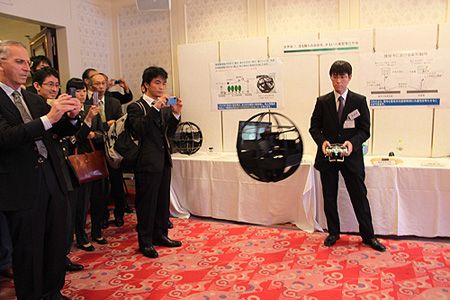
Japanese spherical flying robot
From IEEE Automation: http://spectrum.ieee.org/automaton/robotics/military-robots/japanese-ministry-of-defense-spends-1000-on-flying-robot-soccer-ball
Not much too say about this one, but I like that it lands by just falling on the ground and rolling to absorb the shock (it self rights afterwards). A cool way to transfer energy. It also has one big rotor and it steers with 8 flaps. Also different from all the quadroters I've seen (4 propellers for flying and steering).
Not much too say about this one, but I like that it lands by just falling on the ground and rolling to absorb the shock (it self rights afterwards). A cool way to transfer energy. It also has one big rotor and it steers with 8 flaps. Also different from all the quadroters I've seen (4 propellers for flying and steering).
Subscribe to:
Posts (Atom)